Case file 01 / Independent Project
OptiTalent
Evidence-first recruiting workflows
A multi-tenant recruitment product that turns candidate search, evidence review, shortlist decisions, controlled sharing, and recruiter feedback into one coherent workflow.
- Classification
- Independent Project
- Delivery status
- Independent product / active validation
- Case
- 01 / 07
GitHub Actions / CI
Four runs, with passed and skipped jobs visible.
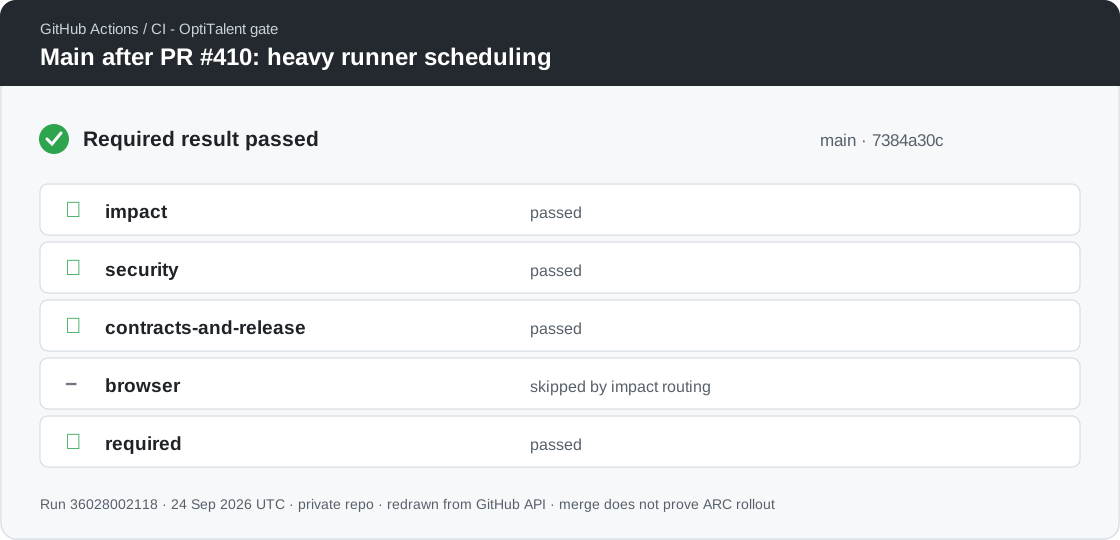
Run 36028002118. Redrawn from a private GitHub receipt; browser was skipped.
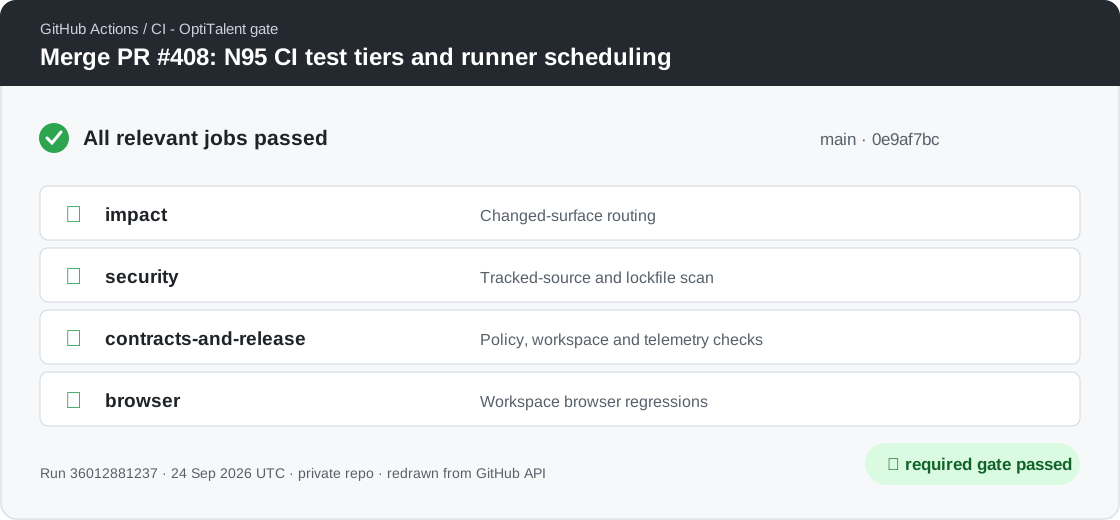
Run 36012881237. All five shown jobs passed on that commit.
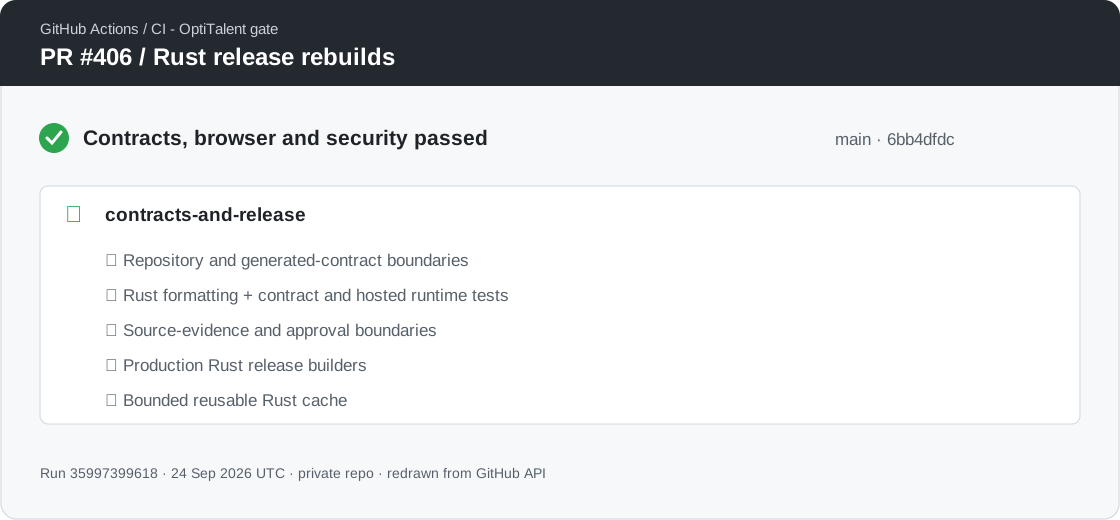
Run 35997399618. This checks source and artifacts, not live deployment.
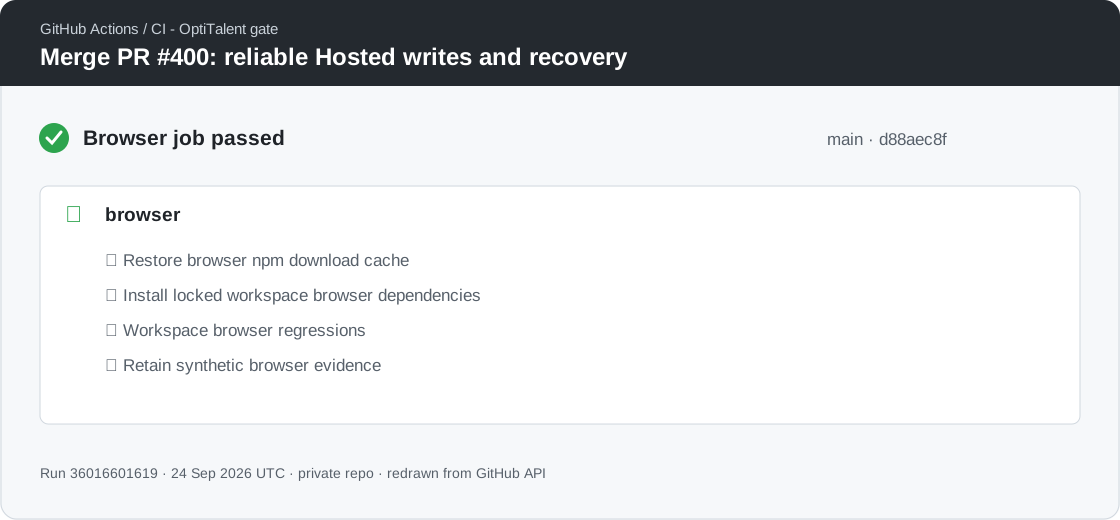
Run 36016601619. Synthetic browser evidence, with no private candidate records.
Runner / release
Checks and deployment have separate boundaries.

PR #410 defines the shared heavy slot. The diagram marks live Helm and scheduling acceptance as unverified.

Steps 01–06 are GitHub source CI; 07–12 are separate Gitea release control. Notes explain skip and approval rules.
Hosted MCP
Sensitive actions need a separate browser approval.

The assistant cannot approve itself. Local tests cover the flow; production readback did not exercise an authenticated task. No users yet.
The problem
Recruiting teams need to move quickly without turning matching into an opaque score or losing the evidence behind a decision.
System arrangement
How the system works
Confirmed role constraints fan into exact and semantic recall lanes. Candidate-level RRF builds the pool, ColBERT refines it, and evidence policy controls what can reach a recruiter shortlist.
- 01SourceRole intent + constraints
Confirmed eligibility compiles first
- 02CapabilityPGlite exact + lexical
Canonical facts, filters, and FTS
- 03CapabilityQdrant dense + sparse
BGE-M3 versioned derived index
- 04CapabilityCandidate-level RRF
Fuses only executed recall lanes
- 05CapabilityColBERT MaxSim
Reranks the fused candidate pool
- 06ControlEvidence policy
Unknown stays unknown, not excluded
- 07OutcomeRecruiter shortlist
Evidence remains reviewable
- 08ControlTenant-local compute
Redacted subjects stay close to data
My role
I defined the product boundaries, tenant model, evidence contracts, recruiter workflow, review gates, and release acceptance. AI agents produced most implementation code under those constraints.
Capabilities
- 01
Hybrid lexical and dense candidate retrieval
- 02
Evidence-preserving reciprocal-rank fusion
- 03
Local embedding and Qdrant recall runtime
- 04
Candidate evidence and explainable match signals
- 05
Draft and approved shortlist states
- 06
Controlled sharing and feedback
- 07
CLI, MCP, desktop, and web access paths
Product decisions
- 01
Prefer evidence-first retrieval and explicit unknowns over a single opaque LLM judgment.
- 02
Place bounded embedding and retrieval work close to tenant data while preserving server-side policy and review authority.
- 03
Keep the policy and lifecycle authority behind stable contracts while interfaces render approved state.
- 04
Treat agent and human entry points as adapters over the same capabilities.
Evidence
- •
Public product surface at app.optitalent.cc.
- •
Implemented candidate search, candidate evidence, shortlist, and sharing contracts.
- •
Tenant-scoped retrieval and explicit review states are present in the product runtime.
- •
LightGBM LambdaRank was evaluated against deterministic baselines on a frozen retrieval protocol and was not selected as the production winner for that feature shape.
My part
I set the product, evidence, approval, tenant, and release boundaries. Coding agents wrote much of the implementation; I reviewed the behavior and delivered system. This is an independent product, not a team-management claim.
What is verified
The GitHub extracts above show exact passed or skipped jobs, not every test on every commit. A September 2026 production readback found healthy gateway and backend containers, MCP enabled, and anonymous MCP requests denied with 401. It did not exercise an authenticated end-to-end user journey.
OptiTalent has no users yet. I claim no adoption, revenue, hiring outcome, or model-quality improvement.